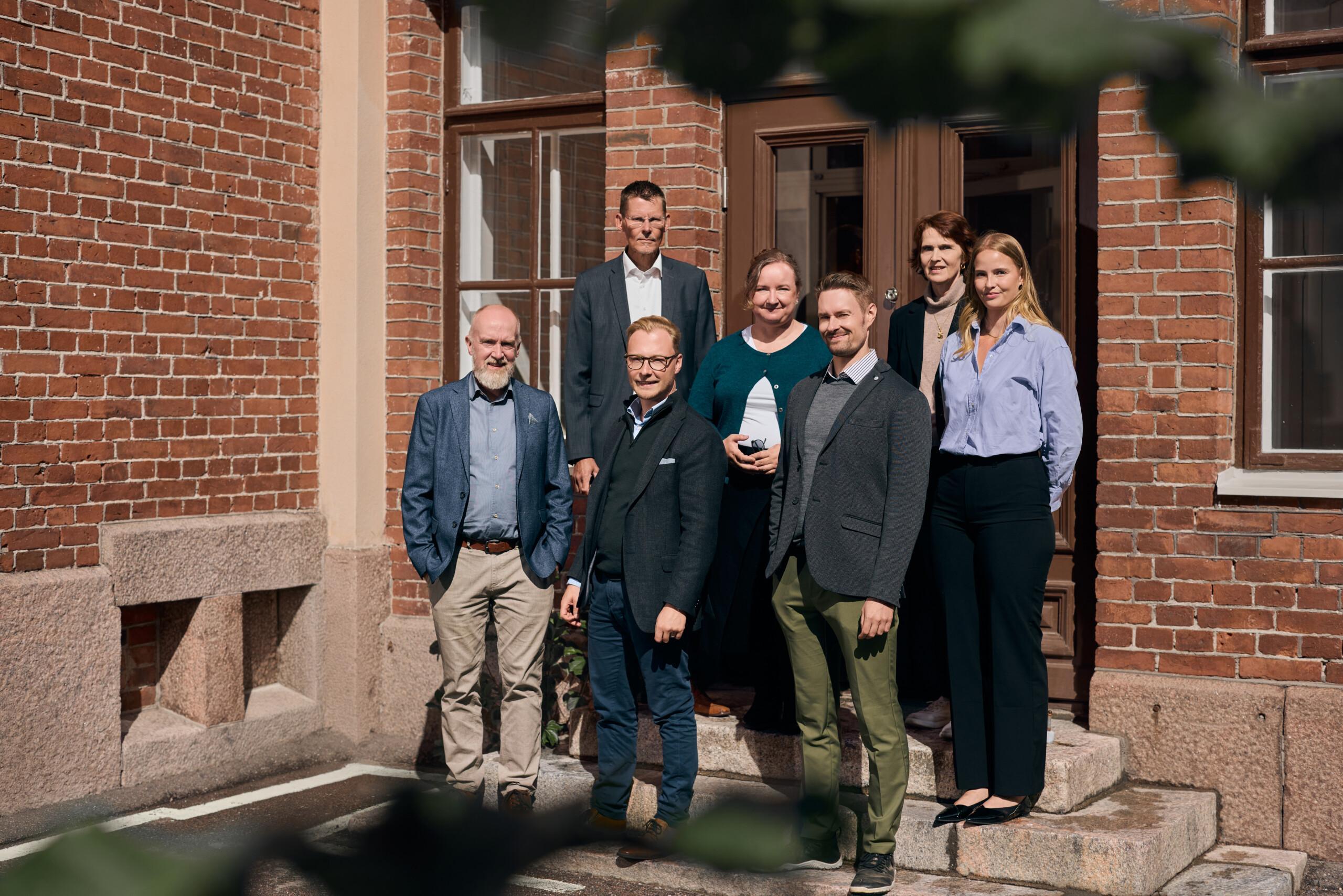
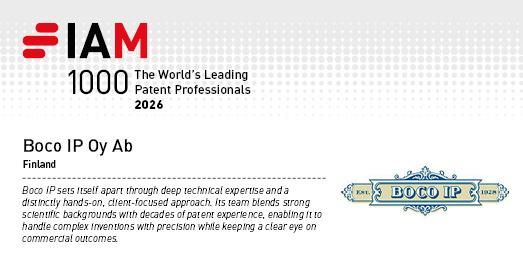
Boco IP Professionals Recognised in IAM Patent 1000 2026 

The IAM Patent 1000 annually evaluates firms and practitioners through extensive client interviews, peer feedback, and independent market research. Professionals are recognised in Gold, Silver and Bronze categories, with additional recognition given to promising experts in the Next Generation category. 

This year, nine Boco IP professionals have been recommended in the IAM Patent 1000 rankings: Boco IP Oy Ab – Patent 1000 – IAM 

  • Karri Leskinen 
  • Jonna Sahlin 
  • Christian Westerholm 
  • Jaana Hämäläinen 
  • Marja Liisa Autti 
  • Sini-Maaria Mikkilä 
  • Thomas Carlsson 
  • Tomi Salter 
  • Nina Virolainen (Next Generation) 

These recognitions highlight the breadth of technical expertise, legal knowledge and client-focused service that define Boco IP. The rankings are based on feedback from clients and industry peers, making them a valuable reflection of the trust and reputation earned by the firm’s professionals. 

“We are delighted to see so many of our colleagues recognised in IAM Patent 1000,” says CEO Karri Leskinen. “These individual rankings are a testament to the exceptional expertise, dedication and professionalism of our team. We are proud of the achievements and grateful for the confidence our clients place in us.” 

The strong representation of Boco IP professionals in the 2026 rankings further reinforces the firm’s position as one of Finland’s leading intellectual property firms and demonstrates its commitment to providing high-quality patent services across a wide range of technologies and industries. 

About Boco IP 

Boco IP is one of Finland’s leading intellectual property firms, providing patent, trademark, design and IP legal services to clients ranging from startups to multinational corporations. With nearly a century of experience, Boco IP combines deep technical expertise with practical business understanding to help clients create, protect and leverage intellectual property assets. 

Narrowing the claim by adding a manufacturing step can broaden protection: EPO Board of Appeal confirms Article 123(3) EPC limits (T 0847/24)

A recent EPO Board of Appeal decision (T 0847/24) confirms a risk we frequently encounter in the European patent practice: an amendment that appears to narrow a claim by adding a manufacturing step may nonetheless extend the scope of protection contrary to Article 123(3) EPC. This decision is particularly relevant in sectors such as medical devices and other digital design-to-manufacture fields, where inventions may span computer-implemented design steps and physical end products.

The central issue: method to product extension via Article 64(2) EPC

The patent at issue in the Board of Appeal decision concerned a computer-implemented method for configuring a physical object in the field of medical implants — essentially generating configuration data for a customised implant based on patient-specific or design parameters. In its granted form, the claim was directed to a method producing data representing the configured implant, rather than directly covering the physical implant itself.

During opposition proceedings, the patentee sought to reinforce the claim by adding an explicit step of manufacturing the configured implant. The apparent intention was to align the claim more closely with commercially relevant embodiments, namely the physical medical device implanted in a patient, and to strengthen enforceability against manufacturers of the final product.

However, this amendment triggered a fundamental legal issue.

The Board confirmed that under Article 64(2) EPC, a process claim confers protection not only on the process itself but also on the product directly obtained by that process. However, this principle only applies within the boundaries of what the granted claim actually defines as the “directly obtained” product.

In the present case, the granted claim did not define a manufacturing process or a process resulting in a physical implant — it was limited to a computational configuration method producing data. Accordingly, the physical implant was not a product directly obtained by the claimed process.

By introducing a manufacturing step, the patentee attempted to shift the claim from a purely data-generating method to a method that produces a physical medical device. This, as the Board concluded, effectively introduced a new category of protection.

The decisive finding: Article 123(3) EPC violation

A key passage of the decision is particularly significant:

“Article 123(3) EPC provides that a European patent may not be amended in such a way as to “extend the protection it confers”. Article 64(2) EPC also addresses the extent of protection. Pursuant to that provision, if the subject-matter of the European patent is a process, the “protection conferred” by the patent shall “extend” to the products directly obtained by such process. In view of the wording of these two provisions and the Enlarged Board’s statement in G 2/88, Reasons 5.1, the present Board considers that assessing a possible extension of a patent’s scope of protection under Article 123(3) EPC must include possible changes of the scope of protection due to Article 64(2) EPC.”

Applying this principle, the Board concluded that auxiliary request 1 extended the scope of protection beyond that conferred by the granted patent. The addition of a production step to a granted computer-implemented method meant that the amended claim extended to medical implants produced by the method via Article 64(2), whereas the granted claims were limited to a method generating the implant configuration data. Because the amendment captured physical implants that were outside the granted scope, the Board found a violation of Article 123(3) EPC and rejected the request.

Why this matters: the hidden expansion risk in “seemingly narrowing” amendments

At first glance, adding a manufacturing step to a method claim may appear to be a limitation — it introduces additional technical features and appears to narrow the claim to a more specific embodiment.

However, this decision highlights a crucial point in European patent law: the assessment under Article 123(3) EPC is not concerned with linguistic narrowing, but with whether the scope of legal protection has changed in substance, including through the effect of Article 64(2) EPC.

A granted computer-implemented method that produces only data does not automatically protect the physical object represented by that data. Consequently, an amendment introducing a manufacturing step can transform the claim into one that covers the production of a tangible medical device, thereby capturing new categories of infringing subject-matter. This is precisely the type of post-grant shift in protection that Article 123(3) EPC is intended to prevent.

Practical implications for patent drafting and prosecution strategy

This decision has important implications not only in medical technology, but also in broader engineering sectors involving digital design-to-manufacture workflows.

1. Be explicit early about product protection intent

Claim strategy at the drafting stage should match the intended enforcement target. If protection of the physical medical device (e.g. implant, prosthesis, or surgical component) is commercially important, we should ideally include in the application:

  • Product claims directed to the implant or device itself
  • Method claims explicitly covering manufacturing steps
  • Computer-implemented design or configuration claims, where appropriate

A robust approach is to ensure that claim sets cover the full digital-to-physical chain where commercially relevant, since post-grant amendments are likely to fail in extending protection.

2. Beware of “upgrade amendments” in opposition and limitation proceedings

In opposition, patentees may try to save a claim by adding manufacturing steps, especially where infringement is expected at the level of physical production. This decision shows that such amendments can fail if they introduce protection for subject-matter not already covered by the granted claims.

Before introducing manufacturing steps, we should carefully assess:

  • Whether the granted claim already implicitly covered the physical product
  • Whether Article 64(2) EPC legitimately extends protection to the manufactured object
  • Whether the amendment introduces a new category of infringing act (e.g. making a medical implant)

If the amendment effectively shifts protection from a data-processing method to a physical product manufacturing method, it is likely to fail under Article 123(3) EPC.

3. Understand the limits of Article 64(2) EPC

This decision reinforces the often misunderstood interaction between Article 64(2) EPC and Article 123(3) EPC. Article 64(2) EPC extends protection to products directly obtained by a claimed process, but it cannot be used after grant to convert a data-generating method into a product-generating manufacturing process.

Broader significance beyond medical devices

Although this case arises in the context of a medical implant technology, the underlying legal principle is not limited to MedTech. It applies equally to any field where a computer-implemented or simulation-based method generates design data and the physical implementation or manufacturing of a product is performed separately.

This includes, for example, additive manufacturing (3D printing), automotive component design, aerospace engineering, industrial tooling, and CAD/CAM-based production systems.

Conclusion

T 0847/24is a clear reminder that amendments must be assessed not only linguistically but by the protection they confer, including the effect of Article 64(2) EPC.

The key takeaway is straightforward: adding a manufacturing step to a claim originally directed to a computer-implemented configuration method can introduce protection for physical products, such as medical implants, that were not previously covered, thereby violating Article 123(3) EPC. For us, patent practitioners, the decision underlines the value of forward-looking claim drafting that reflects the full commercial lifecycle of the invention, from digital design to physical product.


Boco IP Awarded Prestigious Gold Ranking in IAM Patent 1000 2026 

The IAM Patent 1000 is widely regarded as one of the most respected benchmarking publications in the intellectual property field. Rankings are based on extensive independent research, client feedback and peer interviews, assessing firms and practitioners on their expertise, service quality and market reputation. Firms are ranked in Gold, Silver and Bronze categories, with Gold representing the highest level of recognition. 

According to IAM Patent 1000 2026, Boco IP is

“A distinguished Finnish patent agency, renowned for its expertise in patent prosecution.” 

IAM further highlights the firm’s high-quality services, seamless communication, approachable professionals and commitment to innovation. 

“We are honoured to receive this recognition once again,” says CEO Karri Leskinen. “This achievement reflects the trust our clients place in us and the dedication, expertise and collaborative spirit of our entire team. We remain committed to helping innovators protect and maximise the value of their intellectual property.” 

In addition to the firm’s Gold ranking, several Boco IP professionals have been individually recognised by IAM Patent 1000 for their expertise and contributions to the patent profession. These individual recognitions further demonstrate the depth of talent and technical excellence within the firm. 

Boco IP would like to thank its clients, partners and colleagues for their continued trust and cooperation. We are proud to support innovators, startups, growth companies and global enterprises in protecting their most valuable innovations. 

For more information about the IAM Patent 1000 2026 rankings, please visit IAM’s official rankings website: Boco IP Oy Ab – Patent 1000 – IAM 

About Boco IP 

Boco IP is one of Finland’s leading intellectual property firms, providing patent, trademark, design and IP legal services to clients ranging from startups to multinational corporations. With nearly a century of experience, Boco IP combines deep technical expertise with practical business understanding to help clients create, protect and leverage intellectual property assets.

Boco IP was selected as one of the best workplaces in Finland at the Great Place to Work Gala

This recognition is particularly meaningful to us, as the Great Place to Work evaluation is based entirely on employees’ own experiences of their workplace. This was already the 9th time that Boco IP has been listed among the best workplaces in Finland.

In the employee survey, our key strengths were especially equality, team spirit, and meaningfulness work. The survey assessed five areas: credibility, respect, fairness, pride, and camaraderie. The average score across all 60 statements at Boco IP was 97 percent, meaning that 97% of Boco IP employees agreed with the statements.

In recent years, we have developed our everyday work in many ways. We have invested in employee well-being, clarified the company’s vision and strategy, improved the balance of workload distribution, and strengthened self-management.

“This recognition is truly meaningful to us because it is based on the experiences of our own employees. It is great to see that our long-term efforts to enhance well-being at work, team spirit, and equality are also strongly reflected in the results. We want to be a workplace where everyone can be themselves, grow in their work, and feel proud of what we achieve together,” says CEO Karri Leskinen.

It is particularly gratifying that in the open feedback, employees highlighted exactly the aspects we aim to foster in our work community: a safe atmosphere of trust, a sense of community, and pride in one’s work.

Here are some highlights from our employees’ survey responses:

We have a positive work atmosphere, as well as respect and trust toward one another. People are intelligent and highly skilled. There is strong mutual trust, and everyone is treated equally. We are encouraged to develop and learn, and we help each other. Employees do not need to compete with one another; instead, we aim to succeed together. There is a genuine commitment to employee well-being. The employer’s flexibility makes it easier to balance work and family life. Different life situations are taken into account. The people here are amazing! Everyone is welcome to be themselves.

This recognition shows that we are on the right track, and we will continue working toward being a great workplace in the future.

Jonna Sahlin Shortlisted for Practitioner of the Year at the Managing IP EMEA Awards 2026

This prestigious recognition highlights Jonna’s exceptional contributions to the intellectual property (IP) field and her unwavering commitment to delivering top-tier legal expertise.  

The Managing IP Awards are among the most respected accolades in the industry, celebrating excellence in IP law across patents, trademarks, and related areas. Being shortlisted for Practitioner of the Year is a testament to Jonna’s dedication, strategic thinking, and impact in helping clients.

We congratulate Jonna on this well-deserved honor and look forward to the final results of the Managing IP EMEA Awards 2026. Regardless of the outcome, this nomination alone reflects her outstanding contributions and the respect she commands in the IP community.  

Read more about the shortlists here.

Boco IP, one of Finland’s oldest and most respected IP firms, has been providing tailored intellectual property solutions since 1928. Jonna’s achievements reflect Boco IP’s ongoing commitment to excellence and expertise in IP management.   

Boco IP Shortlisted for the Managing IP EMEA Awards 2026 

This recognition highlights Boco IP’s commitment to excellence and client service in the field of intellectual property. 

The Managing IP Awards celebrate outstanding achievements and developments in intellectual property across more than 50 jurisdictions. This year’s awards ceremony will take place on May 1st, 2026, at the InterContinental London.

“We are once again delighted and honored to receive this nomination, which reflects the hard work and dedication of our team in protecting our clients’ intellectual property rights,” says the CEO of Boco IP, Karri Leskinen.  

Being shortlisted for the Managing IP EMEA Awards strengthens Boco IP’s position as a leading intellectual property firm in Finland and internationally.  

For more information about the awards and the full list of nominees, visit the official Managing IP website: Managing IP EMEA Awards 2026: shortlists revealed | Managing Intellectual Property 

Sini-Maaria Mikkilä Ranked 5th in Women’s IP World Ranking 2026

We are pleased to announce that the Top 100 Influential Women Leaders in IP Law has been released. Boco IP’s COO, Partner, and European Patent Attorney Sini-Maaria Mikkilä was ranked No. 5 in Innovation Leadership in Patent Law and Prosecution

According to Women’s IP World ranking: “Securing a top-five rank, Sini-Maaria Mikkilä is distinguished by her integration of patent prosecution and strategic leadership. As Chief Strategy Officer at Boco IP, she orchestrates the protection of industrial assets in automation and energy sectors, ensuring technical innovations drive market dominance. Her expertise in aligning complex patent rights with commercial objectives exemplifies elite-level innovation leadership in patent law and prosecution.” 

More information about the ranking here: Women’s IP World Ranking | Women and woman | Women’s IP World | Greater London 

Essi Karppanen passed the Finnish Patent Attorney Examination

We are delighted to congratulate Essi Karppanen on successfully passing the demanding Finnish patent attorney examination. This is a remarkable accomplishment and a clear testament to her strong expertise in patent matters.

Warm congratulations to Essi on behalf of the whole Boco IP team!

More information about Essi can be found here: Essi Karppanen – Boco IP

Boco IP Recognised in Gold Category for Trademark Prosecution by WTR 1000 2026 Research 

WTR 1000, the World’s Leading Trademark Professionals, is a guide that identifies the top trademark professionals in key jurisdictions around the globe. The WTR 1000 focuses exclusively on trademark practice. 

According to WTR Research, Boco IP is widely acknowledged for combining in-depth legal knowledge with a thorough understanding of clients’ business environments. This enables us to develop tailored prosecution and brand protection strategies that support both domestic and international growth. 

Boco IP’s top-tier prosecution team includes Peter Åkerlund, Elina Heikkilä, Laura Roselius and Jerry Härkönen. Each of them is actively engaged in the international IP community, ensuring that global legal and policy developments are seamlessly integrated into the firm’s prosecution and anti-counterfeiting work. 

Peter Åkerlund is known for his precise and analytical approach to trademark applications, contracts and enforcement matters, bringing long-standing experience to complex infringement cases. Elina Heikkilä is valued for her rigorous clearance work and strategic insight at the early stages of brand development, helping clients build strong and future-proof protection strategies across multiple jurisdictions. 

Laura Roselius brings extensive experience in Finnish, EU and international trademark filings, supported by sophisticated portfolio management skills. She also advises on global design protection and represents clients in oppositions, cancellations, infringement and domain name disputes with sound commercial judgement. Completing the team, Jerry Härkönen combines detailed knowledge of both Finnish and UK legal systems with a practical, client-oriented mindset, addressing brand protection challenges from a broad and effective perspective.  

This Gold ranking reflects Boco IP’s consistent excellence in trademark prosecution and its commitment to providing high-quality, strategic IP services to its clients. 

From left to right: Peter Åkerlund, Elina Heikkilä, Jerry Härkönen, Laura Roselius

Jonna Sahlin Recognized in IAM Strategy 300: Global Leaders 2026

We are delighted to announce that Jonna Sahlin of Boco IP has been named among the IAM Strategy 300: Global Leaders for 2026. 

IAM Strategy 300 Global Leaders is an annual platform for highlighting the world’s foremost IP professionals.  Earning a place among the 300 reflects a reputation for strategic approaches in intellectual property, which is recognized and respected by peers across the globe. 

You can learn more about Jonna Sahlin’s profile here.

Boco IP, one of Finland’s oldest and most respected IP firms, has specialized in intellectual property management since 1928. With a team of seasoned experts and an extensive global network, Boco IP provides tailored solutions to help clients protect and maximize the value of their intellectual property.