








Drafted for success (part 1): stating a technical effect

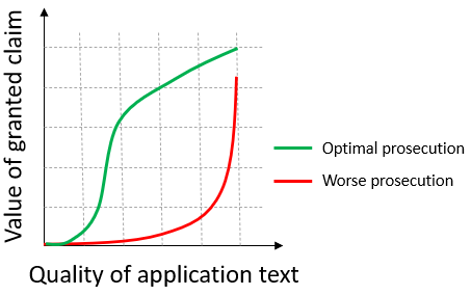
When we write and prosecute a patent application, two factors will greatly influence the outcome: (A) how well we wrote the application (including how correct our understanding of the prior art was), and (B) what we did during prosecution or opposition with the material available to us in the application text (especially in terms of claim amendments and arguments).
As the green curve in the figure below illustrates, even optimal argumentation during prosecution may not yield good value if the application was poorly written (good claim amendments may, for example, be impossible). On the other hand, insufficient arguments (the red curve) will yield significantly worse results than good ones, particularly in the middle of the quality scale.
Recent decisions from the Unified Patent Court, and particularly the Court’s reliance on could-would reasoning, are setting new standards for patent application drafting in Europe. I will here use a recent decision from the EPO Board’s of Appeal to illustrate the value of a high-quality application text in practice.
T 0776 / 24
The claim at issue (auxiliary request 00) in Decision T 0776/24 covered a mass damper formed by twin sheet elements with a zig‑zag geometry, in combination with a guiding arrangement that constrained deformation during a vehicle impact.
The opponent argued that there was no synergy in this combination: (1) the guiding features were associated with stability while (2) the particular sheet geometry could be portrayed as nothing more than an alternative shape for a known damper element. The opponent therefore tried to split the inventive‑step analysis into partial problems that were easier to dispose of using different pieces of prior art.
What prevented that line of reasoning from succeeding was the way the application text explained what the zig-zag geometry was meant to achieve. The description did not merely mention zig‑zag sheet elements; it explained that this configuration ensured smooth compression, led to more uniform deceleration during a collision, and thereby contributed to minimising damage to the vehicle. The advantage of the claimed sheet geometry lay in how the structure deformed under crash loading, how energy was absorbed over time, and how the deformation path influenced deceleration behaviour. This is a fairly complex, dynamic effect.
In EPO proceedings, the applicant is allowed to explain the technical effect of any distinguishing feature (or combination of features, such as the guiding features + the sheet geometry). But this “explain later” strategy works best if the effect is clear and indisputable. The EPO can be more cautious about allowing a complex effect to be attributed to a feature if it is not explicitly disclosed or immediately derivable from a discussion given in the text. The Unified Patent Court’s assessment of inventive step also relies heavily on what the application text teaches.
In T 0776 / 24, once the effect stated in the application text was accepted by the EPO Board of Appeal as real and relevant, the opponent’s attempt to characterise the zig‑zag geometry as a mere alternative design lost its force. The guide was not solving a separate, unrelated stability problem (1); it enabled the damper geometry to deliver the effect that the patent set out to achieve. The Board made it clear that partial-problem splitting is inappropriate where the features interact and jointly contribute to a common technical aim.
The explicit presentation of the technical effect in the patent text was a decisive factor behind this reasoning. Without it, the patent proprietor would have had far less basis to resist the opponents “obvious alternative” argument (2).
Practical implications for drafting:
- We may not want to present the technical benefits of every claimed feature in our application text. It may be unnecessary to do so since we are allowed (at the EPO) to explain technical effects during prosecution or opposition.
- However, if the technical effect is complex, relying on the assumption that it can be discussed when the need arises (without writing it into the application text) is riskier. Explicitly explaining what happens and why it matters in the application text can be the difference between a feature being treated as a meaningful technical contribution (which, we hope, is inventive) or as a mere alternative design (which is less likely to be considered inventive).
- T 0776/24 shows that the explanation of a technical effect need not be elaborate. There was no requirement for experimental data, simulations or quantitative proof. A clear statement linking structure, behaviour and technical benefit was sufficient.
In this sense, T 0776/24 is a reminder that the best foundations for good arguments are often laid long before prosecution, opposition or appeal proceedings begin. When writing new applications, attorneys should make sure they understand the invention in full, claim the necessary features of the invention and explain complex aspects not only from a structural (“what a device contains”) perspective, but also a functional (“what happens”) perspective.
Latest blog articles



Writer