








Auxiliary Requests in EPO Examination


At the European Patent Office, auxiliary requests are very common in oppositions. Procedural efficiency is ensured when the patent proprietor presents possible fallback positions early. Similar efficiency gains may be achieved in examination if the applicant voluntarily chooses to present auxiliary requests when replying to an office action. The fact that the EPO Guidelines contain detailed rules governing the treatment of auxiliary requests in examination suggests that they are not a rarity.
With an auxiliary request the applicant asks the examiner to consider an alternative set of claims (different from the claims presented in the main request) if the examiner deems the main request unallowable. A fallback position is then immediately available for the examiner to review and possibly allow. But although the applicant may appreciate the efficiency of an auxiliary request, potential drawbacks also have to be considered.
How Auxiliary Requests Affect Examination
The main request is examined first, and then the auxiliary requests in the order chosen by the applicant. If a lower-ranking request is the first allowable request, and if the applicant did not request oral proceedings in the event that none of the higher requests is allowed, then the examiner issues a Rule 71(3) communication (intention to grant) based on the lower-ranking, allowable request, while explaining why the higher-ranking requests were considered unallowable. A return to normal examination (the cycle of office actions and responses) is no longer available after that. The only options available to the applicant in the intention to grant stage are:
- accept the grant of the allowable auxiliary request; or
- enter appeal proceedings to maintain the main request.
Consider a situation where we responded to an office action without including an auxiliary request. If the examiner does not agree with our argument, we will usually receive another office action. We can then continue defending the merits of our claim in our next written response, or in a telephone conversation.
In contrast, say we submitted a main request with the same response as above, we also filed an auxiliary request with a narrower claim, and we did not request oral proceedings in the event that our main request is rejected. Let’s assume the examiner did not find the main request allowable but is ready to allow our auxiliary request. We now encounter the examiner’s final reasoning against our main request in the Annex to the R. 71(3) communication, where the examiner announces the intention to grant the auxiliary request. The only route to defend the main request now goes through appeal, which would introduce significant delay.
Another concern is that the fallback position we present in the auxiliary request might make an examiner more inclined to reject the main request. The path of least resistance may appear attractive if a narrower and clearly allowable claim set is already available.
It is therefore advisable to always include a request for oral proceedings in case the main request is not allowed. This will ensure one more discussion about the main request with the examiner before we move on to the auxiliary requests.
Additional questions to consider
Two further questions are important when we consider submitting auxiliary requests in examination:
- How likely is it that the main request will succeed?
- How much additional value does the main request provide compared with the (first) auxiliary request?
The figure below pairs different answers to these questions. Let’s review the cells A – D.
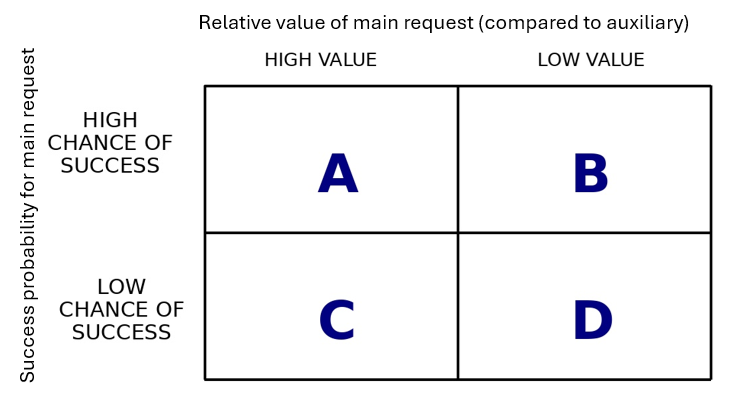
A: High chance of success for main request, large difference in value
We should probably not file auxiliary requests in this situation. Suppose we believe that our main request has an 80-90% chance of success and that the broader claims of the main request would provide significantly greater commercial value than any realistic fallback. It will be preferable to focus the discussion fully on the main request without putting other options on the table.
B: High chance of success for main request, small difference in value
If the chance of success is high but the auxiliary request has almost as much value as the main one, and if we prefer to obtain a patent quickly, then the procedural benefits of auxiliary requests (a potentially faster route to a grant) may outweigh the preservation of continued debate.
C: Low chance of success for main request, large difference in value
The situation is interesting if the main request has a low chance of success and the value difference is large. It could be preferable not to make an auxiliary request, so that we can carefully consider the examiner’s arguments if the main request is rejected, before deciding what to do next. But on the other hand, if we feel we are already making the best possible case for our main request and won’t have much more to say if this argument fails, perhaps we are willing to let it go after one try. We can then file an auxiliary request as a backup option.
D: Low chance of success for main request, small difference in value
This is the situation where auxiliary requests are most attractive. Even if we deem our main request unlikely to succeed, this belief might be incorrect, and the examiner might still surprise us with a grant. But we may not want to continue debating its merits much longer if our initial argument fails. Since the difference in value is small, we can proceed with an auxiliary request, too, if we want to conclude the examination efficiently. This is especially true if we think the auxiliary request has a clearly better chance of success than the main one.
Conclusion
Before filing auxiliary requests, applicants should consider (a) the loss of procedural flexibility and the potential costs and delay that could come with an appeal, (b) the likelihood of success of the main request (and of the auxiliary requests), (c) the value of the claims in both the main and auxiliary requests.
A conditional request for oral proceedings can preserve the opportunity to defend the main request. But if the examiner still rejects the main request after oral proceedings, the applicant will be forced to choose between accepting the grant for an allowable auxiliary request (assuming that one of them was allowable) and appealing the negative decision against the higher-ranking requests which were not allowed.
Latest blog articles



Writer